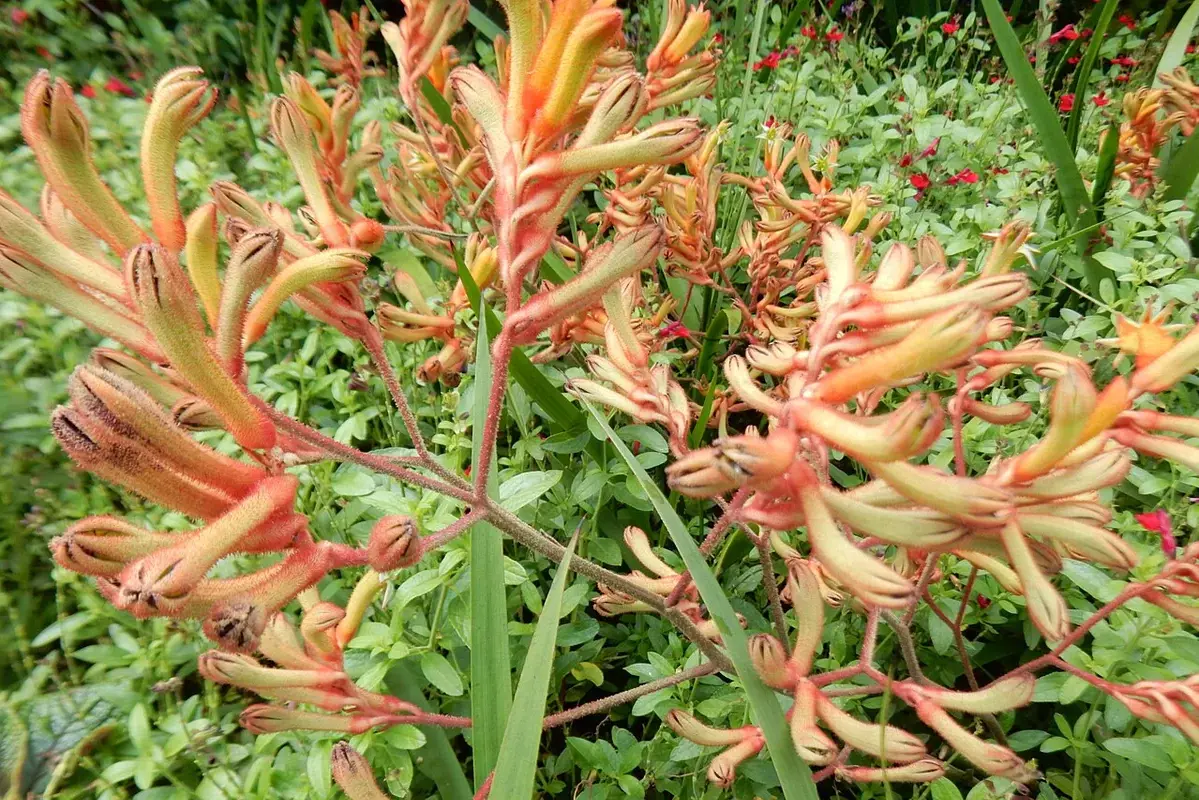
A kangaroo paw stem arrives covered in fine coloured fuzz, with some tubes closed and others opening into small claws. Is the coating dust, and should you brush it away? In Anigozanthos, the hairs are part of the flower and contribute to its colour. Judge the tissue and change over time instead of treating every hairy surface as contamination. This guide works alongside the handling another textured flower without rubbing its head so you can separate the first observation from the next action.
Compare intact tubes on the same stem
Fine coloured hairs distributed over sound tubes are expected. Their colour can differ from the visible tissue inside an opening flower.
Look for the claw rather than a flat petal face
The tubular flower opens at its end. Do not pull the lobes apart to make every flower look equally open.
Find rubbing against dense neighbouring heads
Repeated friction can flatten or damage a textured surface. Leave a gap around the upper branches instead of using them as padding for a heavy bloom.
Track localized moisture and collapse
New wet darkening, tissue failure or suspect growth deserves separation and closer inspection. Colour alone, including a naturally dark cultivar, cannot identify disease.
Read the evidence before acting
A measured care sequence
- 01Confirm the identity
Keep the supplier label and compare the tubular, hairy flowers with a reliable Anigozanthos reference. Unfamiliar black or green colouring alone is not grounds for brushing or bleaching.
- 02Prepare the main stalk
Use a clean cut on sound tissue, remove any foliage that would be submerged and place the stem in a clean supportive vase. Do not strip the upper stalk to make its texture match a smooth rose stem.
- 03Arrange around the branches
Allow each branch to clear nearby petals and the vase rim. Rotate by holding the vessel or lower stalk rather than pinching the flower tubes.
- 04Check the same small area
Photograph one intact tube and any questionable patch. At the next daily check, compare firmness and spread, not merely the contrast between fuzzy outer surfaces and newly exposed interiors.
Keep, adjust or remove?
- Compare intact tubes on the same stemFine coloured hairs distributed over sound tubes are expected. Their colour can differ from the visible tissue inside an opening flower.
- Look for the claw rather than a flat petal faceThe tubular flower opens at its end. Do not pull the lobes apart to make every flower look equally open.
- Find rubbing against dense neighbouring headsRepeated friction can flatten or damage a textured surface. Leave a gap around the upper branches instead of using them as padding for a heavy bloom.
- Track localized moisture and collapseNew wet darkening, tissue failure or suspect growth deserves separation and closer inspection. Colour alone, including a naturally dark cultivar, cannot identify disease.
Keep the hairs that belong to the flower, remove abrasive contact, and act only on real deterioration. A clearer view of one tube is more useful than repeatedly cleaning the whole spray. For a related symptom, return to the handling another textured flower without rubbing its head rather than applying several changes at once.
Research notes
Sources and editorial method
This guide turns general postharvest and preservation advice into visible household checks. Timing and thresholds are starting points: cultivar, harvest stage, transport, room humidity and vase condition can change how a particular flower responds.